The Rise, Achievements, and Enduring Legacy of the Ancient Mayan Civilization
Dive deep into the world of the ancient Mayan civilization—its origins, scientific brilliance, architectural wonders, societal structure, mysterious decline, and lasting legacy in the modern world.

The Mayan civilization stands as one of the most remarkable and intellectually advanced societies of the ancient world. Flourishing across the dense rainforests and plains of Mesoamerica—covering present-day southern Mexico, Guatemala, Belize, Honduras, and El Salvador—the Maya built a sophisticated culture that continues to captivate historians, archaeologists, and travelers alike.
Their civilization spanned more than three millennia, evolving through distinct periods of development, innovation, and transformation. What makes the Maya truly unique is not just their architectural achievements or artistic expression, but their deep understanding of time, mathematics, astronomy, and human existence.
🌄 Origins and Early Development
The origins of the Maya date back to around 2000 BCE, when early agricultural communities began to form. These early settlers relied heavily on farming, cultivating staple crops such as maize (corn), beans, squash, and chili peppers. Agriculture was not just a means of survival—it was deeply tied to their spiritual beliefs and worldview.
As villages expanded, they gradually developed into complex urban centers. By the Preclassic period (2000 BCE – 250 CE), the foundations of Mayan society were firmly established, including social hierarchies, religious systems, and trade networks.
🏙️ The Golden Age: Classic Period
The Classic Period (250–900 CE) marked the height of Mayan civilization. During this time, powerful city-states such as Tikal, Palenque, Calakmul, and Copán rose to prominence. Each city functioned independently, ruled by a divine king known as a K’uhul Ajaw.
These cities were not just population centers—they were hubs of political power, religion, and culture. Monumental architecture, including pyramids, temples, ball courts, and palaces, dominated the landscape. Intricate carvings and inscriptions recorded royal lineages, military victories, and religious events.
Despite their shared cultural identity, these city-states often engaged in alliances and rivalries, leading to frequent warfare.
🔭 Astronomy and the Concept of Time
One of the Maya’s most extraordinary achievements was their advanced understanding of astronomy. Without telescopes or modern instruments, they meticulously observed the movements of celestial bodies such as the sun, moon, Venus, and stars.
They developed multiple calendar systems, including:
Tzolk’in (260-day ritual calendar)
Haab’ (365-day solar calendar)
Long Count Calendar, used to track longer periods of time
Their calendars were so precise that they rival modern astronomical calculations. The Maya used these systems not only for agriculture but also to determine religious ceremonies, political events, and prophecies.
✍️ Writing System and Intellectual Achievements
The Maya created one of the most complex writing systems in the ancient world, composed of hieroglyphic symbols representing sounds, words, and concepts. These glyphs were inscribed on monuments, pottery, codices (books), and temple walls.
Their mathematical system was equally impressive. The Maya used a base-20 (vigesimal) system and were among the first civilizations to independently develop the concept of zero—a revolutionary idea that allowed for advanced calculations and record-keeping.
🏗️ Architecture and Engineering Marvels
Mayan architecture remains one of the most visible and awe-inspiring aspects of their legacy. Their cities were carefully planned, often aligned with astronomical events.
Famous structures include:
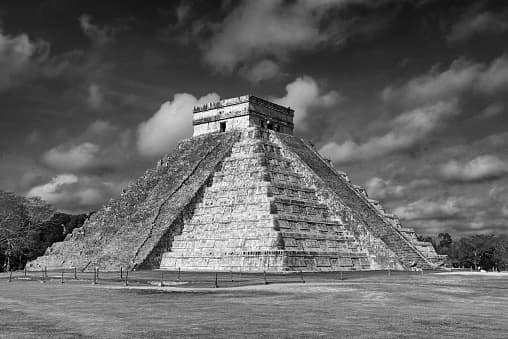
El Castillo (Temple of Kukulcán) at Chichén Itzá, designed to cast a serpent-like shadow during equinoxes
The towering pyramids of Tikal rising above the jungle canopy
The ornate temples of Palenque, known for their detailed carvings
Despite lacking metal tools or the wheel for transport, the Maya constructed massive stone structures with remarkable precision and durability.
⚔️ Society, Religion, and Daily Life
Mayan society was highly structured and hierarchical:
Rulers and Nobility – Political and religious leaders
Priests – Conducted rituals and interpreted the calendar
Artisans and Merchants – Skilled workers and traders
Farmers and Laborers – The majority of the population
Religion was central to every aspect of life. The Maya believed in a complex pantheon of gods associated with nature, the sky, agriculture, and death. Rituals often included offerings, bloodletting, and, in some cases, human sacrifice to appease the gods and maintain cosmic balance.
The famous Mesoamerican ballgame was both a sport and a ritual, symbolizing the struggle between life and death.
🌿 Trade and Economy
The Maya maintained extensive trade networks that connected distant regions. They traded goods such as jade, obsidian, cacao, textiles, and ceramics. Cacao beans were so valuable that they were sometimes used as currency.
Trade not only supported economic growth but also facilitated cultural exchange and technological development.
🌧️ The Mysterious Decline
Around the 9th century CE, many major Mayan cities experienced a sudden decline and were eventually abandoned. This event, often referred to as the “Classic Maya Collapse,” remains one of history’s great mysteries.
Scholars have proposed several theories, including:
Prolonged drought and climate change
Overpopulation and resource depletion
Continuous warfare between city-states
Political instability and societal unrest
It is likely that a combination of these factors contributed to the collapse rather than a single cause.
🌎 The Enduring Legacy of the Maya
Despite the decline of their great cities, the Maya civilization did not disappear. Today, millions of Maya descendants live across Central America, preserving their languages, traditions, and cultural identity.
Modern archaeology continues to uncover new insights into their civilization, aided by technologies such as LiDAR scanning, which has revealed previously hidden cities beneath dense जंगल vegetation.
The Maya legacy lives on in:
Their languages, still spoken by millions
Traditional crafts and agricultural practices
Continued reverence for ancestral traditions
✨ Conclusion
The Mayan civilization was far more than an ancient culture—it was a testament to human ingenuity, resilience, and curiosity. Their achievements in astronomy, mathematics, writing, and architecture place them among the greatest civilizations in history.
Even today, their mysteries continue to inspire exploration and discovery, reminding us that there is still much to learn from the past.

Lorem Ipsum is simply dummy text of the printing and typesetting industry. Lorem Ipsum has been the industry's standard dummy text ever since the 1500s, when an unknown printer took a galley of type and scrambled it to make a type specimen book. It has survived not only five centuries, but also the leap into electronic typesetting, remaining essentially unchanged. It was popularised in the 1960s with the release of Letraset sheets containing Lorem Ipsum passages, and more recently with desktop publishing software like Aldus PageMaker including versions of Lorem Ipsum.
The Letter
Stories. Silence. Light.
Subscribe to The Call of Light.
No spam. Unsubscribe anytime.